In November 2024, Jensen Huang stood in front of a room of investors and named the chain. Compute → Tokens → Intelligence → Digital Workers → Revenue → GDP. Six links, one direction of flow, and a single argument: the AI economy is not an industry — it is a new layer of the global economy. The production of intelligence will become the largest industry on earth.
Read the chain carefully. Five of the links describe production. The sixth, Revenue, describes capture. And capture is doing the work of two distinct stages — the moment value becomes money in a specific company's accounts, and the moment that money aggregates into sector-level change. Jensen's chain compresses them. The framework that names them separately is what the AI economy needs next.
This briefing unpacks the link. Tokens, the unit of inference performed by digital workers, are the new economic primitive flowing through every stage. Industry GTM is where revenue is actually captured — the catalyst layer. Industry Transformation is where that revenue aggregates into rebuilt verticals — the structural outcome. Both are where the largest companies of the next decade will operate.
Jensen's chain — and the link doing the work of two.
The five production links are straightforward. Compute is the physical infrastructure: GPUs, energy, data centres. Tokens are the unit of work — every interaction with a model produces, consumes, and is measured in tokens. Intelligence is what emerges when tokens compose into reasoning, multimodal understanding, autonomous action. Digital Workers are how intelligence becomes labour — applications and agents that perform work humans previously did. Revenue is the money this labour generates. GDP is the aggregation across an entire economy.
Each link is necessary. None is sufficient on its own. And the value migrates rightward: a GPU without a model is a chip; a model without an application is a curiosity; an application without an industry to absorb it is a feature waiting for a buyer. Value flows up the chain, accruing wherever the friction is highest and the substitute is weakest.
The compression problem sits at the Revenue node. When a hospital pays for an AI agent that handles billing, two things happen — first, a specific company captures the revenue that flowed through its product or service; second, the hospital industry shifts incrementally toward AI-native operations. The chain treats these as the same event. They are not. They are the catalyst and the structural outcome.
Unpacking Revenue — catalyst and structural outcome.
The catalyst layer is where revenue is captured by a specific firm. It depends on Industry GTM: the analyst networks, the buyer education, the operator capacity, the trust infrastructure that converts intelligence into purchase. A digital worker is only as commercially valuable as the industry's ability to evaluate, adopt, and operationalise it. That evaluation work has always lived in a specific layer — research firms, trade publications, decision-maker networks, fractional operators. For AI, that layer is being rebuilt because the legacy incumbents (Gartner, Forrester, IDC) were not built around AI-native commercial systems.
The structural outcome is what happens when enough revenue routes through enough firms in a sector that the sector itself changes shape. The hospital industry stops being a labour-intensive operating model with marginal AI assistance and starts becoming an AI-native operating model with marginal human assistance. That is Industry Transformation. It is not faster than the catalyst layer — it is a downstream consequence of it. But it is where the GDP-scale value sits. Sectors rebuilt around AI labour produce different unit economics, different competitive shapes, different cost curves.
The investment implication: anyone counting only the catalyst layer is sizing a market a decade smaller than it actually is. Anyone investing only in the structural outcome is buying terminal positions a decade too early. The framework needs both nodes — and the firms that operate across both will be the dominant operators of the decade.
The economic chain, fully unpacked.
Seven nodes. Two distinct phases. The first phase produces intelligence — compute, tokens, intelligence, digital workers. The second phase captures and aggregates it — industry GTM, industry transformation, GDP. Public markets have spent two years pricing the production phase. The capture phase has barely been priced.
Seven nodes, two phases, one direction of flow.
The asymmetry is now visible. Compute (Node 01) has been re-rated for two years. Tokens (Node 02) have become the unit of trade. Intelligence (Node 03) and Digital Workers (Node 04) are mid-rerating, with the application layer still uncertain about who captures and who commoditises. Nodes 05 and 06 — the capture and aggregation phase — have not yet been re-rated because most of the firms that will dominate them either do not exist yet or are not at scale.
Industry GTM — where revenue is captured.
The Industry GTM node is the catalyst layer. It is where a digital worker meets a buying decision and the buying decision meets a payment. Every other link in the chain produces intelligence in the abstract; Industry GTM converts that intelligence into a specific firm's revenue, in a specific industry, against a specific competitive set.
Three things have to be true at this node for value to be captured. First, the buyer must be able to evaluate the digital worker against a comparable benchmark — which requires an evaluation infrastructure, traditionally provided by analyst firms and trade publications. Second, the buyer must trust the deployment will work in their specific context — which requires an operator network with sector experience, traditionally provided by consulting firms and senior practitioners. Third, the buyer must be able to adopt the digital worker without internal capacity bottleneck — which requires fractional or full-time talent that has done the deployment before.
None of those three components map cleanly onto AI in 2026. The legacy evaluation firms (Gartner, Forrester, IDC) were built around enterprise software cycles, not AI agents. The legacy consulting firms were built around process implementation, not autonomous workforce deployment. The legacy talent pool was built around running campaigns and managing teams, not building autonomous systems. Each component is being rebuilt. The firms that get the rebuild right capture the Industry GTM layer for AI.
Industry Transformation — the structural outcome.
Where Industry GTM is the catalyst, Industry Transformation is the consequence. Once enough firms in a sector route enough revenue through AI-native operations, the sector itself stops being a labour-intensive operating model. Cost curves drop. Competitive moats reshape around data, integration, and orchestration rather than scale of human labour. Unit economics diverge from incumbents who bolted AI on. New entrants who built AI-native from day one outcompete incumbents on speed and margin.
This is the GM-to-Tesla move applied across every industry: not a new tier above incumbents, but a competitive replacement with fundamentally different unit economics. The pattern recurs across every foundational technology wave — and AI is the third.
Industry Transformation is where the GDP-scale value sits. But it depends entirely on Industry GTM being functional. Without the catalyst layer, revenue never reaches the firms that compound into the structural outcome. The two nodes are not independent — they are a sequence.
Old vs New Go-To-Market — seven dimensions.
Industry GTM as a layer has a shape, and that shape is structurally different from the GTM function that defined the SaaS era. Seven dimensions tell the story. Each is a place where the old operating model and the new operating model diverge — not in degree, but in kind.
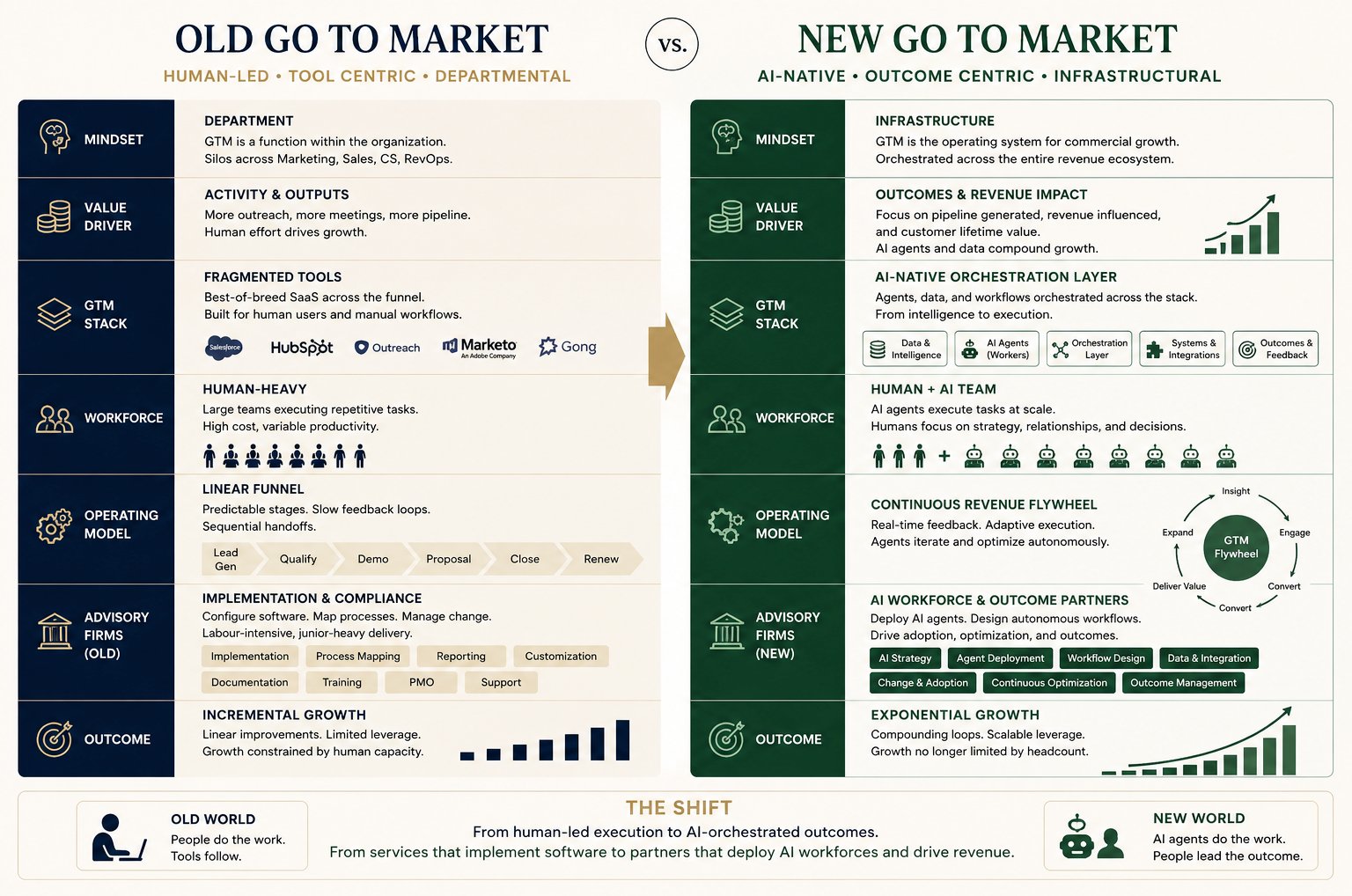
The dimensions read as a single argument. The old mindset treats GTM as a department; the new mindset treats it as infrastructure. The old value driver is activity and outputs; the new value driver is outcomes and revenue impact. The old stack is best-of-breed SaaS; the new stack is an AI-native orchestration layer. The old workforce is human-heavy; the new workforce is human plus AI team. The old operating model is a linear funnel; the new operating model is a continuous revenue flywheel. The old advisory firms implement and configure; the new advisory firms deploy AI workforces and drive outcomes. The old outcome is incremental growth; the new outcome is exponential growth, no longer constrained by headcount.
Tokens and compute become national output.
Step all the way back to the end of the chain. GDP is the sum of value produced across an economy. When digital workers perform a rising share of that production — and when the tokens they consume are produced by compute located inside a country's borders — the chain stops being a story about companies and becomes a story about nations. Tokens and compute are no longer line items in a technology budget. They are inputs to national output.
This reframes the opportunity at the GDP node. A country's AI capacity is now a function of three things it can actually own: the compute it can site and power, the tokens that compute can produce, and the share of its industries that can absorb those tokens as productive labour. Each is a sovereign lever. Each maps to a different layer of the chain. And each is being competed for — by governments, not just companies.
The GDP impact runs through both. Compute determines how many tokens a country can produce. Tokens determine how much digital labour it can deploy. Digital labour determines how much its industries can transform. And industry transformation, aggregated, is GDP growth that is no longer bounded by population or working hours. For the first time, a country can grow output without growing its workforce — provided it owns the compute and the tokens underneath.
This is the new opportunity created at the GDP level — and it is asymmetric. Countries that treat compute and tokens as sovereign infrastructure, the way they once treated electricity, ports, and broadband, will compound output across every transformed sector. Countries that import their intelligence the way they import finished goods will capture the consumption but not the production — and the production is where the GDP accrues. The chain that began with a single GPU ends as a question of national competitiveness.
The takeaway for capital allocators.
Three reframes follow from unpacking the Revenue node into Industry GTM and Industry Transformation.
The unit of trade in the AI economy is the token. The layer where tokens convert to money is Industry GTM. Confusing the two — sizing the AI economy by token volume or compute spend rather than by the catalyst layer that captures revenue — produces a market estimate an order of magnitude smaller than the actual addressable opportunity. The total economic value of AI is not the price of inference; it is the revenue captured by the firms whose digital workers are deployed at scale, and the GDP-scale transformation of the sectors that absorb them.
Public markets have priced the production phase — compute, tokens, intelligence, partially digital workers. The capture phase has barely been priced because the firms that will dominate it either do not exist yet or are not at scale. The legacy incumbents in evaluation (Gartner, Forrester), consulting (the Big Four, MBB), and talent (traditional staffing) were not built for AI-native commercial systems. The opening is for AI-native firms with the right operating model. That opening compounds for at least the next decade.
Industry Transformation — entire sectors rebuilt around AI labour — is the largest economic opportunity of the next decade. Most of it is not yet investable at scale. The AI-native hospitals, retailers, banks, and manufacturers are early-stage. Industry GTM, by contrast, is investable now — the catalyst firms that will own the analyst layer, the benchmark layer, the operator network, and the AI-workforce orchestration capability for the next decade are being built today. Whoever owns the catalyst layer earns optionality on the structural outcome.