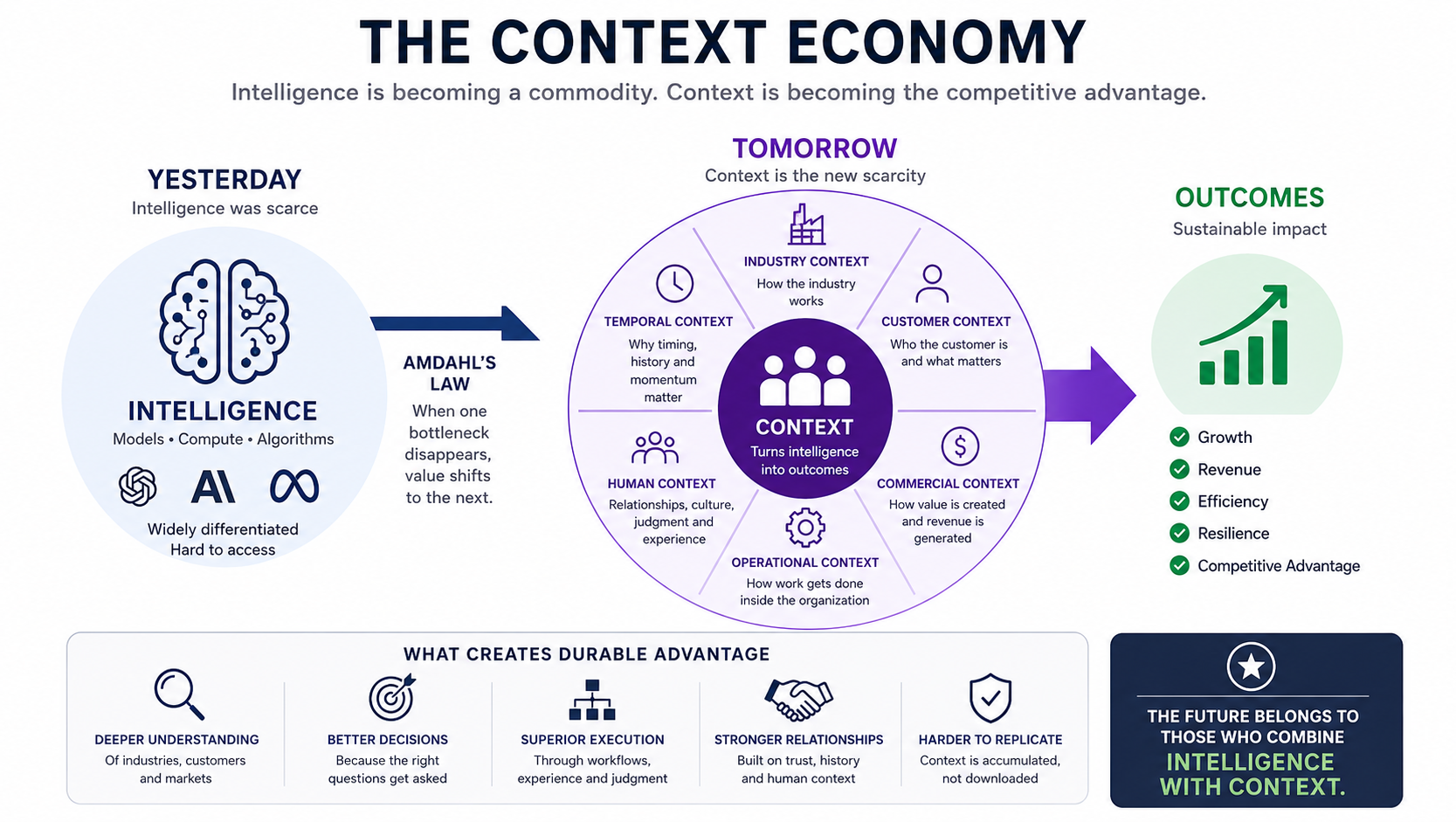
Every technological revolution removes a constraint. Steam power reduced our dependence on human and animal labour. The internet reduced the cost of communication. Cloud computing reduced the cost of infrastructure. Artificial intelligence is reducing the cost of intelligence itself — and for the first time, organisations of every size can reach extraordinary reasoning, language, research and software capability through foundation models.
This is one of the most significant shifts of our lifetime. But it raises a strategic question the daily AI conversation tends to skip: if intelligence becomes abundant, where does competitive advantage come from next? The most useful answer may lie in a principle that is almost sixty years old.
When one bottleneck disappears, another emerges.
In 1967, the computer architect Gene Amdahl introduced a principle that became foundational to systems thinking: improving one component of a system only improves overall performance until another component becomes the limiting factor. Remove today's bottleneck, and tomorrow's appears. Though Amdahl was describing computers, the pattern holds across business, economics, and every technological revolution — value migrates, relentlessly, toward whatever remains scarce.
For the past several years, intelligence has been the primary constraint. Today it is rapidly becoming abundant. Which forces the next question: what becomes scarce now? We believe the answer is context.
Intelligence is not the same as context.
Give the same AI system to two executives — one fresh from university, one who has spent thirty years running a global bank. Both now hold identical intelligence. Their decisions will still diverge, because intelligence alone does not determine decisions. Context does. As AI becomes more capable, context may become the defining source of advantage.
Same intelligence, different judgement.
What context is — and its six dimensions.
Context is often confused with data. They are not the same. Data is information; context is everything that gives information meaning — industry expertise built over decades, customer relationships earned through experience, the commercial models that decide how value is created, the operational workflows refined over years, sector-specific regulatory knowledge, organisational memory that lives in no single document, and human judgement. Context cannot simply be downloaded. It is accumulated, refined, experienced, and applied.
Organisations create value when several forms of context work together. Six dimensions matter most.
How a specific sector actually operates — its regulations, economics, terminology, competitors and operating models. The grammar of the market.
Who the customers are: their objectives, relationships, buying behaviour, history and current priorities. Not a persona — the real account.
How value is actually created and captured: pricing, margins, sales cycles, buying committees and partner ecosystems.
How work really happens: processes, approvals, dependencies, workflows and execution — the difference between a plan and a result.
Leadership, trust, culture, relationships, experience and judgement. Many of the most important business decisions remain deeply human.
Timing. Markets evolve, competitors respond, regulations change, cycles shift. The same recommendation can be excellent today and ineffective tomorrow. Context is dynamic.
The context economy — and why industries matter.
The first generation of AI learned from publicly available information. The next will increasingly create value through proprietary context — not more documents, but deeper understanding. The organisations that win may not be those with the largest models, but those that combine widely available intelligence with uniquely valuable context. That is a fundamental shift in where competitive advantage lives.
It is also why industries matter. Every industry develops its own language, economics, workflows, regulations, customer expectations and definition of success. Healthcare is not banking; banking is not logistics; logistics is not manufacturing; manufacturing is not professional services. General intelligence can explain an industry. Context determines whether AI can operate effectively inside it. The largest opportunity in enterprise AI may not be building more intelligent systems, but systems that understand industries more deeply — the same thesis this Review has developed on the unowned industry layer and the great rewiring of the $500T economy.
Lessons for founders and boards.
Many founders begin with "how do we build an AI company?" The more strategic question is "what unique context can only we provide?" Technology alone is unlikely to become the moat. Context might.
Board discussions tend to begin with AI. They might begin with context instead — moving the conversation beyond technology adoption and toward strategic differentiation.
The GTM Bench perspective.
At GTM Bench we believe the next phase of enterprise AI will not be defined by larger models or faster compute, but by the ability to combine intelligence with deep industry understanding, commercial experience, and practical execution. Technology amplifies expertise; it does not replace it. The organisations that thrive will not simply deploy AI — they will operationalise context.
The operator's takeaway
History suggests technology rarely eliminates constraints; it moves them. AI has dramatically reduced the cost of accessing intelligence. The next challenge is making that intelligence relevant — and context is what turns information into judgement, capability into advantage, and intelligence into business outcomes. The first generation of AI made intelligence widely available. The next may be remembered for something more valuable still: context.